

68 articles Found
-

The First Nativity
Many of us cherish the hand-carved Italian wooden nativity with its crèche and hanging angel given to us as a gift, or a large Fontanini Nativity we bought when we first got married. Maybe you have a burnished gold one-piece nativity passed down through the family, or you have your eye on a stained glass nativity. During the holiday season, our yard is bedecked with a beautiful, illuminated, larger-than-life nativity. Now, we might think this tradition goes all the way back to the first Christmas in Bethlehem so many years ago. You may be surprised to learn that the tradition began with Saint Francis of Assisi:
In the early part of the thirteenth century, Saint Francis of Assisi was troubled by the lack of holiness in the holiday season. There was a lot of drunkenness and desire. The fact that God came to earth as a man seemed to be lost in the preparations for the feasting and merrymaking.
As Francis often did when he was troubled, he went to a cave on Mount Subasio and prayed. In his solitude, an answer came to him: he remembered the humble birth of our Lord. Saint Francis came up with a plan to remind people of the real reason we celebrate Christmas.
For weeks, he prepared. Three of the monks were dressed as Kings. Other monks would come as shepherds. A farmer agreed to loan him a donkey, a cow, chickens, and sheep. He found a carpenter to portray Joseph and a beautiful young maiden to portray Mary.
It was Christmas Eve, and everything was set. He chose a cave on the edge of the village of Greccio because it reminded him of the biblical description of the manger. Even in his own time, Saint Francis was well known. When word went out that he had arranged a special celebration of Christmas, people came from far and near.
(Imagine now that you are standing on the side of this hill, near the cave. It is just past sunset, and the light is fading from a rose colored sky. Looking out over the valley, you see hundreds of people gathering. Some are carrying torches, others candles. Each person carries their light. From each home and village, a stream of light flows towards the cave. These streams of light gather into a river of light. Soon, a flood of light flows up the hill to the mouth of the cave. Each of us brings our small light to make an ocean of light.)
Just as everyone arrived, Saint Francis realized that he had forgotten something. The shepherds and sheep were there, so were the three kings and their horses. There was a donkey, a cow, and some chickens sleeping or scratching in the straw. Mary and Joseph were there. How could he? He had forgotten the most important thing! Saint Francis had forgotten the baby!
Just then, he saw a spark in the straw. At first, he thought the spark had leapt from a candle or torch, and Saint Francis leapt to put it out. But then it took shape. A small ball of fire began to grow and softly glow. Right before the eyes of a thousand seekers, the glowing light took the shape of an infant. For the second time, God came to earth as a child. Everyone present witnessed a miracle.
Francis could not let the baby rest on the cold stone floor of the cave. He scooped the Christ child up into his arms and cuddled him. It dawned on him then and there, the true meaning of Christmas.
God came to earth not as a king but as the child of a poor carpenter. He was not born in a palace but in a manger among animals. Saint Francis realized God is there to take care of us, yes, but we also must nurture that of God within.
Though chaste, in that moment, Saint Francis gave birth. For a moment, he knew the pleasure of fatherhood. He also gained a deeper appreciation of our Father and his infinite wisdom. What a blessing for us all!
And so it has been to this day: throughout the world, we celebrate the birth of Christ with the celebration of the nativity, an idea inspired by a poor man from Assisi.
Do you have a special nativity that you place near the tree at Christmas?
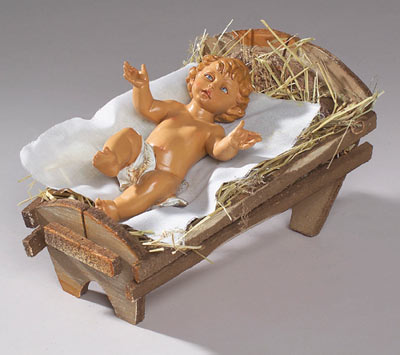
Whether your nativity set is tabletop or garden statues, when you arrange the decorations on your mantel or in your front yard, think of Saint Francis and this story, the first celebration of the nativity. And maybe, just as they do in Italy, you may wish to set the kings and camels at a distance on the first night and inch them closer each day to remind us of that journey we all must make to be nearer to God. Keep the baby Jesus under wraps and place Him in the manger on Christmas Eve to remind us of the real reason for the holiest of seasons.
*This traditional story is based on the medieval book, “The Little Flowers of Saint Francis” and is retold by Brian “Fox” Ellis, author and storyteller. © 2008 All rights reserved. www.foxtalesint.com
-

Saint Stories: St. Thérèse of Lisieux
Saint Thérèse of Lisieux or Saint Thérèse of the Child Jesus and the Holy Face, O.C.D. was a Roman Catholic French Discalced Carmelite nun who had a fathomless devotion to the Child Jesus. As such, she has become known for her affection for the small things and the Holy Face.
Born in France in 1897, she grew up in a strictly devout Catholic household, where she often played pretend that she was a nun. She was a happy child until she age four-and-a-half, when her mother died. She became more insular and introspective, a quiet observer.
When her two older sisters were cloistered at the Carmelite monastery, the future "Little Flower of Jesus" yearned to follow in her sisters' footsteps. She often went through periods of mental anguish and tremors, and was wracked with pathological guilt over religious issues. However, on Christmas Eve in 1886, at age 13, Thérèse felt the sudden presence of the Christ Child within her. Her anxieties were replaced with a deep feeling of grace. Two years later, on April 9, 1888, she became a Carmelite postulant. As she advanced into novitiate, Thérèse began to practice small virtues and became engrossed in the idea of littleness, often referring to herself as a grain of sand. She studied, wrote and contemplated the Holy Face.
Due to her youth, her novitiate was extended until September 8, 1890, at age 17 and a half, when she was at last allowed to make her final commitment. On the eve of the ceremony, she was again wracked with guilt and panic, until the next day, when she was filled with an overwhelming sense of peace. For years she continued her devotions, doing small acts of charity, accepting more bullying with silence and grace, and turning her thoughts always to the Child Jesus. She decided not to become a full sister, preferring to write and teach her "little way" of living.
On Good Friday 1896, Thérèse woke after coughing up blood - a fatal sign of tuberculosis. She suffered greatly over the next year before her death on September 30, 1897, aged 24.
Quick Facts about St. Thérèse of Lisieux
Feast Day: October 1
Best known for: Being a French Discalced Carmelite nun popularly known as "The Little Flower of Jesus" or simply "The Little Flower."
Born: January 2. 1873
Died: September 39, 1897
Beatified: April 29, 1923
Canonized: May 17, 1925 -

Saint Stories: Saint Teresa of Avila
Saint Teresa of Avila was born in Avila, Spain in 1515, two years before Martin Luther nailed his 95 Theses on the door of All Saints' Church in Germany. Born to a strict, pious father and a loving mother, Teresa was shaped by each. It was from her mother, who died when Teresa was just 14, whereupon the future saint learned to love romance novels, which were strictly forbidden by her father. This created conflict in Teresa's inner struggle and turmoil.
When Teresa was seven, she convinced her brother Rodrigo to find martyrdom with the Moors outside Avila's city walls. It was their uncle who found the two children outside the city walls and brought them home unharmed. Her faith continued to be a strong influence as she grew older. At the point when she was asked to choose between marriage or a life with the church, she was conflicted. She observed that her mother suffered under a difficult marriage. Yet she thought a life as a nun would not be joyful. Yet, her choice to live a religious life was made to save her from the temptations of sin. She joined a Carmelite convent and learned the practice of mental prayer.
Teresa continued to be tempted, as the convent she was in allowed a more lenient lifestyle for nuns, and allowed Teresa to let her vanity take hold. When she later made plans to join a new convent that practiced a simple life of poverty devoted to prayer, her convent threatened an inquisition, and the town started legal proceedings against her. After more years at her first convent, she finally felt it was time to spread her reform movement. She received a patent from the Carmelite general Rubeo de Ravenna to establish a new house in her order. In a time of religious turmoil, persecution, and reformation, Teresa was seen to point the way from outer turmoil to inner peace for herself and those around her.
Quick Facts about St. Teresa of Avila
Born March 28, 1515
Died October 4, 1582 at age 67
Venerated in the Roman Catholic Church, Lutheran Church, Anglican Communion
Beautified on April 24, 1614 in Rome by Pope Paul V
Canonized March 12, 1622
Feastday: October 15
Symbol: A book and quill, and an arrow-pierced heart -

Saint Stories: Saint Nicholas
The story of Santa Claus is well known. He spends the year in the North Pole with his elves in preparation to bring gifts to good boys and girls. The story behind St. Nicholas is even more endearing. Nicholas was born in the third century to a wealthy Greek family in the village of Patara, located on the southern coast of modern Turkey. While still a young boy, his devout Christian parents died during an epidemic, after which Nicholas became even more devout. He took the words of Jesus, "sell what you own and give the money to the poor," to a very strict interpretation, and used his inheritance to help the needy, the sick and the suffering.
Nicholas' good work helped him rise to become the Bishop of Myra at an early age for such titles. He continued to be generous to those in need, and shared care and concern for children, sailors and ships.
Christians were persecuted under the Roman Emperor Diocletian, and Bishop Nicholas was exiled and imprisoned. Through his imprisonment and release, Nicholas' faith never faltered. He died on December 6, AD 343 in Myra and was buried in the cathedral church where he served in his years as a Bishop. In his grave a liquid substance believed to be a relic called manna formed, and this substance is said to have healing powers, and promoted devotion to Nicholas. Despite the fact he died in the 3rd century, his spirit of giving lives on today.
Quick Facts about Saint Nicholas
Feast day: December 6 (December 19 on the Julian Calendar)
Patronage: Children, coopers, sailors, fishermen, merchants, the falsely accused, repentant thieves, brewers
Venerated in: Anglicanism, Baptism, Catholicism, Eastern Orthodoxy, Oriental Orthodoxy, Lutheranism, Methodism, Presbyterianism -

Saint Stories: Saint Lucy
While much of the history around Lucy has been lost, what is known about her story is legendary. At a young age, Lucy pledged herself in service of Christ, yet when she approached marrying age, her mother agreed to an arranged marriage for Lucy with a pagan man. Soon after, Lucy's mother became ill. Lucy prayed for her mother, and Saint Agatha appeared to her in a dream, telling her that Lucy's mother would be cured through faith. Her mother recovered from her illness soon after, and Lucy went ahead with her vows to Christ, leaving her betrothed spurned and angered. Her onetime bridegroom reported Lucy's faith to the governor, who ordered his guards to take action.
Every attempt to punish Lucy was thwarted almost as if by an unknown protector. She was ordered to defilement in a brothel; however, guards could not move her. Guards tried to burn her, but were unable to light bundles of wood placed around her. Finally, guards used their swords to gouge Lucy's eyes out and ultimately killed the devout Christian martyr in the same manner. When Lucy was prepared for burial, it was observed that her eyes were restored.
Saint Lucy died during the Diocletian Persecution. Her legend was spread through the region and was recognized in Rome, where she was venerated as a saint by the Roman Catholic, Anglican, Lutheran, and Orthodox churches. Saint Lucy is often shown in paintings and other images holding a golden plate or cup containing her eyes. She often holds a palm branch to symbolize her victory over evil.
Quick Facts about St. Lucy
Feast Day: December 13
Lived in Syracuse
Canonized during pre-congregation
Symbolized by eyes on a plate or in a cup
Lucy means "light" or "lucid"
Patron saint of the blind and those with eye-trouble -

Saint Stories: St. Joseph
Saint Joseph was a craftsman with an enormously important destiny. Appearing first in the Gospels of Matthey and Luke, the descendant of King David was engaged to a young virgin girl named Mary when he found out she was pregnant. He fully intended to break off the marriage, until an angel appeared to him and told him not to be afraid, for his beloved was pregnant with none other than the Son of God. Joseph did indeed marry Mary.
When a decree of the Roman Emperor Augustus required that Joseph return to his hometown of Bethlehem to register for a Roman census, Mary went with him. Finding no room at a local inn, she gave birth to her son in a stable, wrapping him in swaddling clothes and laying him in a manger. Some time later, after a premonition that King Herod was planning to murder the baby Jesus, the Holy Family escaped, eventually settling in Nazareth.
Joseph is last seen in the Gospels when he and Mary find their 12-year-old son, Jesus, in the Temple, where he speaks to them of his father, the Lord God. Mary is depicted as a widow for the rest of her son's ministry. He does not appear to take charge of Jesus' body after his Crucifixion, as custom suggests, and Mary's continuing caregiver is instead John the Apostle. Later, in apocryphal texts, it is suggested that he died at age 111, having never consummated his marriage with Mary, who remained a virgin her entire time on Earth.
In 1870, Joseph was named the Patron Saint of the Universal Church and is considered the model of the pious believer.
Quick Facts about Saint Joseph
Feast Day: March 19, May 1
Best known for: Being the husband of the Blessed Virgin Mary and devoted foster father of Jesus Christ.
Born: c. 90 BC (apocryphal)
Died: July 20, AD 18 (apocryphal) -

Saint Stories: St. John of the Cross
Saint John of the Cross was a major figure in the Counter-Reformation, a Spanish mystic and a Carmelite friar and priest. His efforts toward reformation, along with Saint Teresa of Ávila, lead to the creation of the Discalced (barefoot) Carmelite Order, a separate province devoted to returning to the order's original vocation. He is known for his poetry and writings about the soul, generally believed to be the apex of mystical Spanish literature, and is considered one of the most important writers in all of Spanish literature.
In 1542, John was born in Spain to a former accountant father and a lower-class weaver mother. When John's father had married his mother, his family disowned him, forcing him to work also as a weaver. John's father died when John was three years old, and John's brother soon followed, likely dead from malnutrition.
John went to school for poor children and orphans, where he received a basic education and served as an acolyte at a monastery. As he grew older, he worked at a hospital and continued his studies at a Jesuit school. He joined the Carmelite Order in 1563, and traveled to Salamanca to study philosophy. He intended to return home and join a strict order, but met a nun named Theresa of Jesus, later to become Saint Teresa of Ávila. She spoke about her plans for reformation and a return to stricter ways, and he agreed to join her. Around 1575, he had a vision of Christ on the crucifix and changed his name to John of the Cross. His drawing of the incident, depicting Christ from above, would later inspire Salvador Dali.
Things grew dire as opposition to the reformation grew. In 1577, a group of Carmelites kidnapped him and took him to stand trial, despite the fact that he had permission to start his own order. John was imprisoned and tortured for nine months, before escaping. He finished the poetry he started writing in prison and continued his reformation work. In 1591, he grew gravely ill and died December 4 of the skin condition erysipelas, also known as St. Anthony 's fire.
Quick Facts about Saint John of the Cross
Feast Day: December 14
Best known for: Speaking about the "dark night of the soul" one encounters on the path to fully serving God.
Born: 1542
Died: December 14, 1591
Beatified: January 25, 1675
Canonized: December 27, 1726 -

Saint Stories: St. John the Baptist
St. John the Baptist professed to his crowds that he was nothing, and that the coming Messiah was everything. His 1st century BC birth to Zechariah and Elizabeth was miraculous because both parents were older. His mother had been through menopause and had even been unable to have children during child-bearing years. While performing duties as a priest in a temple in Jerusalem, Zechariah learned of the impending miracle. As the priest burned incense, Zechariah was told by the angel Gabriel that Elizabeth would bear a child, that they would name him John, and that he was destined for a special purpose.
Today St. John is revered in the Christian church as the forerunner or precursor to Jesus Christ, but he is also recognized in other religions, including Judaism, Islam, Baha'i Faith and Mandaeism. In the Quran, he is known as the prophet Yahya.
As a modest man, John believed in a messianic figure greater than himself, and baptized those who repented ahead of the coming of God's Final Judgment. John spent a period of solitude in the desert, often referred to his time preaching in the wilderness. Later, he resided in the lower Jordan Valley region, where he gained disciples, including Jesus. John believed one would come who would not be baptized with water, but baptized with the Holy Spirit. This belief was realized when John baptized Jesus in the river Jordan. As Jesus emerged from the water, the Holy Spirit descended from the heavens to Jesus like a dove. A voice from heaven was heard to say, "You are my Son, the Beloved; with you I am well pleased."
St. John the Baptist is described in the fourth gospel as a man sent from God to bear witness to the light. With this witness of the light, everyone would believe through John.
St. John the Baptist is discussed in four Gospels, including Matthew, Mark, Luke and John.
Quick Facts about St. John the Baptist
Born: Late 1st century BC
Died: AD 31-36
Feast Days include June 24 (Nativity); August 29 (beheading); January 7 (Synaxis, Eastern Orthodox)
Patronage: Patron saint of Jordan, Puerto Rico, Knights Hospitaller of Jerusalem, French Canada, Newfoundland, Cesena, Florence, Genoa, Monza, Perth (Scotland), Porto, San Juan and Turin -

Saint Stories: Holy Mary
Mary's incredible story begins in the Gospels of Matthew and Luke, in the New Testament. A teenage Galilean Jewish virgin, Mary was engaged to a carpenter named Joseph when she miraculously conceived her son by the Holy Spirit. Luke begins his account of Mary's life with the Annunciation, when the angel Gabriel appeared to her and told her she had been chosen to bear the Messiah. When Joseph took note of her pregnancy, he intended to leave her, but another angel of the Lord told him that she was to bear the Son of God, and that he should marry her without hesitation.
When a decree of the Roman Emperor Augustus required that Joseph return to his hometown of Bethlehem to register for a Roman census, Mary went with him. Finding no room at a local inn, the Blessed Virgin gave birth to her son in a stable, wrapping him in swaddling clothes and laying him in a manger. Some time later, after a premonition that King Herod was planning to murder the baby Jesus, the Holy Family escaped, eventually settling in Nazareth.
Mary appears again in the only account of Jesus' adolescence, when she finds him at the Temple. Later, she suggested he perform his first miracle - turning water into wine. She appears again throughout Jesus' life until his Crucifixion, for which she was also present. As such, Mary is often depicted in art cradling her the body of her son, the Lamb of God.
After Christ's ascension, Mary is mentioned by name when returning from Mount Olive, but then never again. The Holy Mother's death was not recorded in the scriptures, but in Catholic, Orthodox and other churches, it is doctrine that she was directly assumed into Heaven.
Quick Facts about Holy Mary
Feast Days: January 1, January 8, February 2, February 11, March 25, May 13, May 31, June 27, August 15 (holy day of obligation,) August 22, September 8, September 12, September 15, October 7, November 21, December 8 (holy day of obligation,) and December 12.
Best known for: Being Mary Mother of God, the Blessed Virgin.
Born: September 8, c. 18 BC (traditional; celebrated as the Nativity of Mary)


